
1. Get the Linkspank toolbar for Firefox at http://www.linkspank.com/toolbar. It is far and away the fastest way to share links on the web. You also have the option to view a news ticker and you can save pages with a click for later browsing.
You can send your spanks to Facebook and to Twitter at the same time as individual email addresses! Use these tools:
2. Add the facebook app at http://apps.facebook.com/linkspank The app is not super pretty right now, and the page to import your friends takes about fifteen seconds. But once you have the app in, you can spank individual facebook friends, and post links to your facebook wall at the same time as you send them to email or facebook people. Plus you'll enjoy better features as I improve the facebook app.
3. Add your twitter account at http://www.linkspank.com/twitter You can see what spanky tweets look like on my Twitter profile: http://www.twitter.com/bitchell.
Showing posts with label twitter. Show all posts
Showing posts with label twitter. Show all posts
Thursday, February 26, 2009
Friday, June 20, 2008
Representativeness Bias in the Tech Industry
In business school Dick Thaler taught us about the representativeness bias, which could be crudely stated as the bias of over-weighting everything you're familiar with when making judgments, estimates and guesses about stuff. Dr. Thaler convinced me in class that we all fall prey to this bias far more often and with a greater deepness of error than we imagine, even after the bias has been explained to us.
 Dick Thaler taught us about representativeness bias
For people in the tech industry, the representativeness bias can lead to (1) an over-estimation of the penetration of a product or service, either in awareness or usage, and, on the flip side, (2) an under-estimation of potential market sizes. As someone in the tech industry, you are a techie and you know lots of techies. Hence when all the techies you know start using a website, say Twitter, you overestimate how much people use Twitter or even know about Twitter. On the flip side, you underestimate how much Twitter has at stake to win by capturing the uncaptured market, or how badly some other service could thrash Twitter by grabbing the uncaptured market.
 less of a big deal than people say
(though I wish them luck)
To stick with Twitter for a moment: how many people use Twitter? About a million. If they were all in America (which they aren't), they would number 1 American out of every 300. Hey, that doesn't sound like very much! How much of the remaining 299 out of 300 Americans do you think have heard of Twitter? Hint: *much* less than half! In other words, no one knows about this service, given that it's supposed to be something that any old person with a phone and friends can enjoy. Now, I like Twitter. But this is a service that is supposed to be as neat and as of general interest, as, say Facebook, which has 80 million users. If you needlessly chop a huge portion off that number to be "conservative," you have a potential market for a Twitter-like service of 50 million people. So, in user accounts, Twitter has penetrated 2% of its potential market. Basically, it's sucking big time. You'd be inclined to ask yourself if it's designed wrong, marketed wrong, or environmental factors are against it. Some conclusions: (1) Twitter is overhyped; (2) the idea of trying to build a better Twitter is undervalued. Now I don't mean to pick on Twitter exclusively. It's true for any site you like, to varying degrees. You can even say it about Facebook. Facebook's membership -- again even if you inflate it by counting everyone as an American -- compromises about a quarter of the country. That's a heck of a lot of people. But it's also outnumbered 3 to 1 by the non-Facebook users. For a site whose goal (according to me) is to be entertaining enough to compete with sitting around and watching television, it's a massive but still quite incomplete advance.
 With a relentless focus on the mass market, Jobs avoids the representativeness bias of techiedom and can think big, score big
A great example to the contrary is the iPhone. As you may recall, Steve Jobs made some pretty bold sales forecasts for the iPhone before it was launched. If iPhone had been viewed in terms of the "smartphone" market, Jobs would have seemed crazy. But he was thinking correctly. You could say that the smartphone market was like Twitter - cool, but nowhere near the size it was supposed to be. He wanted to go for the real market, which was more of a Facebook type size (to continue the analogy). Of course, don't go saying that "everyone" knows about the iPhone now! ;-)
This logic inspired my foray into Linkspank. A tech insider may think of the competitive arena for link sharing, social news, or whatever you want to call it, as saturated. But the reality is quite the opposite. One of the biggest sites in this area - Digg - has only a few million users. Compared to the size of the market -- for really any person you likes YouTube, reads news on the web, or gets or receives email forwards is a potential user of such a site -- Digg is a little sniveling baby.
It IS true that the small minority of people who use Twitter, for example, may be different from the other 97-99% of Americans in some meaningful way... but I'll leave that point alone at this time.
Here's another, slightly more fun example. You know those "viral videos" on YouTube and elsewhere that "everyone" has seen? The all-time most viewed video on YouTube, the Evolution of Dance:
It has been viewed about 90 million times, which is say about 90 million people. By comparison, an estimated 140 million people view some part of the Super Bowl each year. So, while it's impressive, it still falls a bit behind the Superbowl Halftime Show (estimating, since that's not what the previous figure refers to). And that is the number 1 video - the number of views drops off VERY quickly as we go down the list. Still in the top ten is the "laughing baby video, which has a mere 50 million views:
It's pretty funny, and a lot of people have watched it, but unless you live on a special techie-only planet, you know more people who HAVEN'T seen this video than you know who HAVE seen it. Fewer than 1 in 6 Americans has seen it (once again, with my grotesque the-world-is-America math).
People like to talk about the magic of a technology that has enabled 50 million people (if views = people) to watch something filmed casually in someone's kitchen. And it is magical, I agree. But looking at the numbers closely turns the viral video concept a little bit on its head. Our popular notion is that something catches fire on the web and then "everyone" sees it. But the reality is that sharing is still rather inefficient, and it's more right in many respects to think that "no one has seen anything." :-)
Linkspank addresses this problem in a few ways: it lets you share more videos and links with your friends, without inconveniencing them (since they can manage their Inbox and email settings). You can also see which of your friends have already received a spank. So rather than being a part of the problem, be a part of the solution (haha): join the spank and spank this page to your friends, so they can read this nifty article... and catch up on the Evolution of Dance and the Laughing Baby.
 Dick Thaler taught us about representativeness bias
For people in the tech industry, the representativeness bias can lead to (1) an over-estimation of the penetration of a product or service, either in awareness or usage, and, on the flip side, (2) an under-estimation of potential market sizes. As someone in the tech industry, you are a techie and you know lots of techies. Hence when all the techies you know start using a website, say Twitter, you overestimate how much people use Twitter or even know about Twitter. On the flip side, you underestimate how much Twitter has at stake to win by capturing the uncaptured market, or how badly some other service could thrash Twitter by grabbing the uncaptured market.
 less of a big deal than people say
(though I wish them luck)
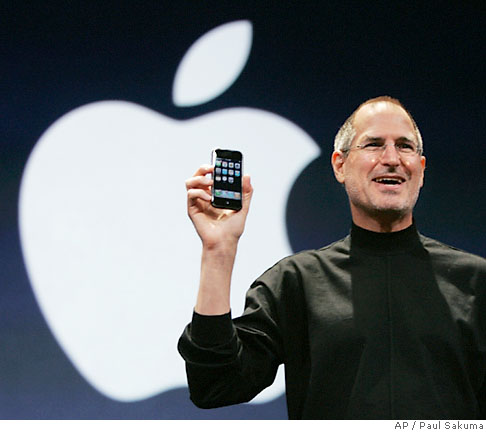 With a relentless focus on the mass market, Jobs avoids the representativeness bias of techiedom and can think big, score big
A great example to the contrary is the iPhone. As you may recall, Steve Jobs made some pretty bold sales forecasts for the iPhone before it was launched. If iPhone had been viewed in terms of the "smartphone" market, Jobs would have seemed crazy. But he was thinking correctly. You could say that the smartphone market was like Twitter - cool, but nowhere near the size it was supposed to be. He wanted to go for the real market, which was more of a Facebook type size (to continue the analogy). Of course, don't go saying that "everyone" knows about the iPhone now! ;-)
This logic inspired my foray into Linkspank. A tech insider may think of the competitive arena for link sharing, social news, or whatever you want to call it, as saturated. But the reality is quite the opposite. One of the biggest sites in this area - Digg - has only a few million users. Compared to the size of the market -- for really any person you likes YouTube, reads news on the web, or gets or receives email forwards is a potential user of such a site -- Digg is a little sniveling baby.
It IS true that the small minority of people who use Twitter, for example, may be different from the other 97-99% of Americans in some meaningful way... but I'll leave that point alone at this time.
Here's another, slightly more fun example. You know those "viral videos" on YouTube and elsewhere that "everyone" has seen? The all-time most viewed video on YouTube, the Evolution of Dance:
It has been viewed about 90 million times, which is say about 90 million people. By comparison, an estimated 140 million people view some part of the Super Bowl each year. So, while it's impressive, it still falls a bit behind the Superbowl Halftime Show (estimating, since that's not what the previous figure refers to). And that is the number 1 video - the number of views drops off VERY quickly as we go down the list. Still in the top ten is the "laughing baby video, which has a mere 50 million views:
It's pretty funny, and a lot of people have watched it, but unless you live on a special techie-only planet, you know more people who HAVEN'T seen this video than you know who HAVE seen it. Fewer than 1 in 6 Americans has seen it (once again, with my grotesque the-world-is-America math).
People like to talk about the magic of a technology that has enabled 50 million people (if views = people) to watch something filmed casually in someone's kitchen. And it is magical, I agree. But looking at the numbers closely turns the viral video concept a little bit on its head. Our popular notion is that something catches fire on the web and then "everyone" sees it. But the reality is that sharing is still rather inefficient, and it's more right in many respects to think that "no one has seen anything." :-)
Linkspank addresses this problem in a few ways: it lets you share more videos and links with your friends, without inconveniencing them (since they can manage their Inbox and email settings). You can also see which of your friends have already received a spank. So rather than being a part of the problem, be a part of the solution (haha): join the spank and spank this page to your friends, so they can read this nifty article... and catch up on the Evolution of Dance and the Laughing Baby.

Wednesday, February 13, 2008
this blog just got way more micro (I'm talking about Twitter)
I just checked out the Social Media Breakfast. Was cool, thanks Bryan.
The thing was basically a huge Twitter lovefest. It helped me to think a little deeper about the service.

Anyway, I'm going to try the twitter things for people who for some reason think it's interesting to follow the individual firings of my synapses. That place will be
twitter.com/bitchell
I'll still blog here, of course - when it's more than just a snippet.
You can see that I used my (sort of) real name rather than "linkspank" as my twitter handle. The reason: twitter is not about companies, but rather people. A huge portion of what I do is "Inside Linkspank" type stuff. But there will be & has to be other junk in there too, because when you go high volume the line gets blurry between this & that. Some people raised an eyebrow at the user name "bitchell." I raise an eyebrow back at them. I'm like hey, What do you expect from a person who names a site Linkspank? ;-)
The thing was basically a huge Twitter lovefest. It helped me to think a little deeper about the service.

1. Often I want to blog here, but my thought is "too small" for a blog post, or maybe a bit off topic. Reason to try Twitter.
2. Facebook status updates are fun, and I have previously been of the opinion that they killed the need for twitter. But now I'm understanding that the whole game of twitter is VOLUME.
You COULD do a high volume of status updates in facebook, but that's not really quite what it's for and your friends are likely to get bummed. Twitter is designed more to be high volume.
Actually this scenario is similar to Linkspank - you can post a link on facebook, but you can't do it in high VOLUME efficiently (i.e. without spamming your friends). Enter Linkspank, and your world is awesome - more content, bigger brain, bigger laughs.
Anyway, I'm going to try the twitter things for people who for some reason think it's interesting to follow the individual firings of my synapses. That place will be
twitter.com/bitchell
I'll still blog here, of course - when it's more than just a snippet.
You can see that I used my (sort of) real name rather than "linkspank" as my twitter handle. The reason: twitter is not about companies, but rather people. A huge portion of what I do is "Inside Linkspank" type stuff. But there will be & has to be other junk in there too, because when you go high volume the line gets blurry between this & that. Some people raised an eyebrow at the user name "bitchell." I raise an eyebrow back at them. I'm like hey, What do you expect from a person who names a site Linkspank? ;-)
Subscribe to:
Posts (Atom)

 Posts
Posts


